
When living with chronic illness, it can feel phenomenal to wake up one day with less pain, a clearer head, or even a slight decrease in your symptoms.
It can feel exciting to think about finally getting some of the things done that you have been having to put off.
Seeing friends.
The housework.
Getting out for a walk.
Whatever you can cram into the day.
But towards the end of the day, or at bedtime, the symptoms start to creep back in.
The following day?
Wham.
They’re back full force.
From the outside, this can be confusing.
But capacity can, and does, fluctuate. It can genuinely change, seemingly without prior notice, rhyme or reason.
You can have days when you are able to do the food shopping.
Days when you can go downstairs.
Days when moving from the bed feels impossible.
Living with chronic illness is like carrying an invisible weight with you every day. You wake up and live a life where you don’t necessarily know what your body, brain or symptoms are going to allow that day.
So when those days arise where you feel a little bit like the ‘old you’, it is completely understandable that you want to make the most of it.
The thing is, when we cram everything into that window of capacity, it can come at a cost.
This is often described as the ‘boom and bust’ cycle.
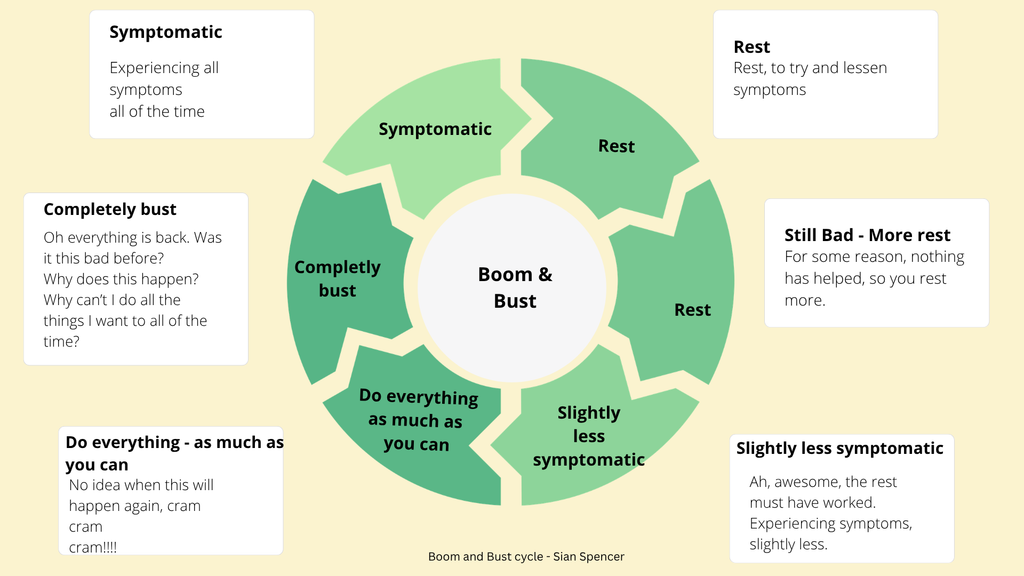
Chronic illness isn’t as clear-cut as:
- Good days = can do everything
- Bad days = can’t do anything
And that is just another factor that can make living with chronic illness so confusing and exhausting.
There are so many things that can influence how you feel from week to week, day to day, and even hour to hour.
Navigating that alone can be difficult.
Your symptoms can make it incredibly hard to see patterns, and even thinking about trying to work out what might be affecting your capacity can become another source of overwhelm.
This is where I come in.
When I support someone living with chronic illness, we look at your life as a whole.
We explore the things that may be using up your capacity, the things that help you preserve it, and the things that genuinely make a difference to how you feel.
Then we look for simple, realistic adjustments that work within your life.
Not a rigid routine.
Not a list of things you ‘should’ be doing.
Not another thing to add to the pile.
Just practical ways to support your energy and mental wellbeing.
So that your support gives something back, rather than taking more from you.
If you would like to know more about working with me, you can find out more about my Chronic Illness support here.
 The Author
 The Author
Sian Spencer
Founder of Diverse Living Devon, a neurodiversity support and mentoring service based in Devon.
With over 13 years of professional and lived experience, she supports neurodivergent people, their families, and professionals in understanding sensory processing, behaviour, emotional regulation, communication, and practical everyday challenges.
Her articles draw on professional experience, lived experience, ongoing professional development, current evidence, and years of real-world practice. She is passionate about making complex topics accessible, helping people better understand themselves and others through practical, compassionate, and evidence-informed guidance.
The information shared in these articles is intended to educate, encourage understanding, and provide practical strategies. It should not replace personalised medical, therapeutic, or legal advice.